


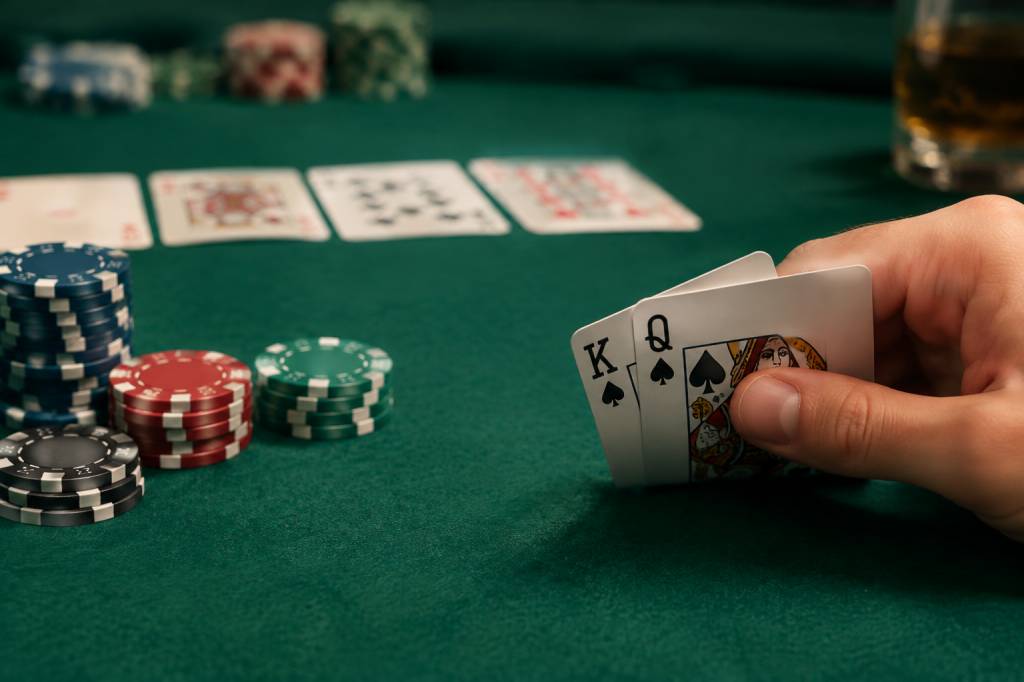
Picture the scene: you are holding two pair, the board looks wonderfully harmless, and you are already imagining the chips sliding your way. Then your opponent turns over five cards in perfect sequence. Suddenly, your impressive-looking hand is about as useful as a chocolate helmet.
So, does two pair beat a straight in poker? No. A straight ranks higher than two pair in the standard poker hand rankings. It does not matter whether your two pair is aces and kings or a modest pair of sevens and fours. If your opponent has a completed straight, your two pair is heading for the muck.
That sounds simple, but poker hands have a habit of creating confusion at precisely the moment the pot becomes interesting. Let’s break down the rankings, examine how two pair and straights work, and look at the details that can save you from making an expensive table-side mistake.
The short answer: a straight beats two pair
In most popular poker formats, including Texas Hold’em, Omaha and five-card draw, the standard ranking places a straight above three of a kind? Not quite. This is one of those details worth getting right: three of a kind beats two pair, but a straight beats three of a kind as well.
The relevant section of the standard ranking is:
- One pair
- Two pair
- Three of a kind
- Straight
- Flush
- Full house
- Four of a kind
- Straight flush
That means a straight beats two pair every time, assuming both hands are valid and no stronger hand is hiding in the cards. Your two pair may look attractive, particularly when one of those pairs is made with your hole cards, but poker does not award style points for a hand that looks tidy.
A straight is made from five cards in consecutive numerical order, regardless of suit. For example:
- 5♠ 6♦ 7♣ 8♥ 9♠
- 10♣ J♦ Q♠ K♥ A♣
- A♦ 2♣ 3♥ 4♠ 5♦
Two pair consists of two cards of one rank, two cards of another rank, and one unrelated card. For example, K♠ K♦ 8♣ 8♥ 3♠ is kings and eights with a three kicker.
When these hands meet, the straight wins. There is no tiebreaker involving the value of the pairs. A pair of aces does not magically leapfrog a straight, despite aces behaving like they own the place.
What exactly is two pair?
Two pair is a five-card hand containing two different pairs. The fifth card is called the kicker. The hand is ranked first by the higher pair, then by the lower pair, and finally by the kicker if necessary.
Imagine two players reach the showdown with these hands:
- Player one: A♠ A♦ 7♣ 7♥ K♠
- Player two: A♣ A♥ 7♦ 7♠ Q♣
Both players have aces and sevens, so the kicker decides the winner. The king kicker beats the queen kicker.
If the higher pair differs, that is the first comparison. Kings and fours beat queens and jacks, for instance, because the kings are the stronger top pair. If the higher pair is identical, compare the lower pair. Only when both pairs match do you inspect the kicker.
In Texas Hold’em, players use the best five-card combination available from their two hole cards and the five community cards. You do not have to use both hole cards, or even one of them. This is where many beginners get ambushed by the board.
Suppose the board is:
10♣ 10♦ 6♠ 6♥ 2♣
Every player has two pair, tens and sixes, unless someone can make a stronger hand with a hole card. The player with the highest remaining card in their best five-card hand may win with the kicker. Your pocket ace could matter. Your opponent’s king might not be enough. Poker is a game of five-card hands, not a beauty contest for the cards in your hand.
What makes a straight?
A straight contains five consecutive ranks. Suits do not matter. You can have four hearts, four clubs or five different suits and still have a straight, provided the ranks run in sequence.
Examples include:
- 4-5-6-7-8, known as an eight-high straight
- 9-10-J-Q-K, known as a king-high straight
- 10-J-Q-K-A, the highest possible straight
The ace is slightly unusual. It can be used as the highest card in 10-J-Q-K-A, or as the lowest card in A-2-3-4-5. It cannot wrap around the sequence. Q-K-A-2-3 is not a straight, no matter how confidently somebody announces it at the table.
The ace-to-five straight is often called a wheel, and it is the lowest possible straight. Even a wheel still beats two pair. A humble 5-high straight is stronger than aces and kings in two pair form, which can feel deeply unfair if you have just improved to top two pair. The cards have no sympathy.
When comparing two straights, the highest card determines the winner. A 9-high straight beats an 8-high straight. A king-high straight beats a queen-high straight. If both players have exactly the same straight, the pot is split.
A practical Texas Hold’em example
Let’s say you are playing a cash game and hold:
A♠ K♦
The board comes:
A♥ K♣ 8♠ 7♦ 6♣
Your best hand is two pair, aces and kings, with an eight kicker. That looks strong, and against many holdings it is. However, a player holding 9♣ 5♣ has a 5-6-7-8-9 straight. Their straight beats your aces and kings.
Now imagine the opponent has 9♣ 10♣ instead. They also have a straight, 6-7-8-9-10, which still beats your two pair. It does not matter that your pairs are higher in rank. Hand categories are compared before individual card values.
This is the key principle:
- First compare the type of hand.
- If both hands are the same type, compare the relevant card values.
- Use kickers only when the rules for that hand require them.
It is the same reason a flush beats a straight even when the straight contains higher individual cards. The category comes first. Poker rankings are hierarchical, not a free-for-all where every card argues its own case.
Why two pair can feel stronger than it really is
Two pair is a visually satisfying hand. You can see the matching ranks sitting there, doing their job. It is usually stronger than one pair and often strong enough to win a small pot. The trouble begins when players treat it as an automatic monster.
Two pair is vulnerable to several hands:
- Three of a kind
- A straight
- A flush
- A full house
- Four of a kind
- A straight flush
In other words, two pair is respectable, but it is not invincible. On a connected board, the danger of a straight should be obvious. A board such as 7♠ 8♦ 9♣ creates immediate possibilities for players holding a six, ten, or both. If you hold two pair on that board, slowing down is usually wiser than charging forward with your eyes closed.
Board texture matters. A hand like aces and kings on A-K-4-2-2 is generally safer than aces and kings on A-K-9-10-J. The second board practically comes with a warning label and a small siren.
Reading the board for straight possibilities
To avoid paying off a straight, train yourself to scan the community cards for connected ranks. Look for three or more cards that could combine with a player’s hole cards to form five in sequence.
For example, consider these boards:
- 5♣ 6♦ 9♠ K♥ 2♣: very few straight possibilities
- 6♣ 7♦ 8♠ K♥ 2♣: a player with a 5 or 9 may have a straight
- 10♣ J♦ Q♠ 3♥ 4♣: an ace or king alone does not complete a straight, but the board is worth monitoring
- 8♣ 9♦ 10♠ J♥ 2♣: any queen or seven makes a straight
Notice the difference between an open-ended straight draw and a gutshot draw. With 6-7-8-9, either a five or a ten completes a straight. With 6-7-9-10, only an eight does. Both situations matter, but the first creates more possible completed straights.
When you hold two pair, ask yourself a few practical questions:
- What straight draws were available before the final card?
- Did the river complete an obvious sequence?
- Can my opponent realistically hold the missing rank?
- Is their betting line consistent with a straight?
- Am I calling because the hand is strong, or because I do not want to fold it?
That final question has cost me more chips than I care to count. Poker players can be remarkably loyal to two pair, as if the hand personally helped them move house.
Does a flush beat a straight and two pair?
Yes. A flush beats a straight, and both beat two pair. A flush consists of five cards of the same suit, regardless of sequence. For example, A♥ 9♥ 7♥ 4♥ 2♥ is an ace-high flush.
This creates another common source of confusion. On a board with three or four cards of the same suit, two pair may be facing both straight and flush possibilities. If the cards are connected and suited, the situation becomes especially dangerous because a player could potentially have a straight flush, which ranks even higher.
For instance, a board of 8♥ 9♥ 10♥ 2♣ 3♦ gives opponents opportunities to hold a flush, while a player with J♣ 7♠ can make a jack-high straight. Your two pair may be technically strong compared with one pair, but the board is offering too many routes to stronger hands.
What if the straight is on the board?
If the five community cards themselves form a straight, every player has at least that straight available. Unless somebody can make a higher straight using a hole card, the pot is split.
Suppose the board is:
5♠ 6♦ 7♣ 8♥ 9♠
The board provides a 9-high straight to everyone. A player holding 10-J can make a higher straight, 7-8-9-10-J, and wins. But a player holding two pair cannot use those pairs to beat the board straight. The best five-card hand remains the straight.
In Hold’em, the board is shared property. You cannot claim two pair from your hole cards while ignoring a stronger five-card hand sitting in plain sight among the community cards. The best legal five-card hand always plays.
Simple strategy when you hold two pair
Two pair is often a betting hand, but the correct decision depends on the board, position, opponents and action. Against one opponent on a dry board, betting for value can be excellent. Against several players on a coordinated board, caution becomes more valuable.
Keep these habits in mind:
- Value-bet two pair on safe boards against weaker pairs and draws.
- Reduce your confidence when a straight or flush draw completes.
- Pay attention to large raises, especially on connected rivers.
- Do not assume top two pair is unbeatable.
- Remember that a straight beats two pair regardless of how attractive your pairs look.
- Use pot odds and opponent tendencies rather than relying only on the absolute strength of your hand.
Folding two pair can feel painful, particularly when you have invested money across several streets. But previous bets are gone. They are not a reason to continue; they are merely the price of reaching the current decision. A disciplined fold is not weakness. It is how you keep your stack alive for the next hand when the deck decides to stop being dramatic.
The ranking to remember at the table
If you only remember one thing, remember this: two pair is below three of a kind, and a straight is above three of a kind. Therefore, a straight beats two pair.
A quick mental ladder can help:
- Pair
- Two pair
- Three of a kind
- Straight
- Flush
- Full house
- Four of a kind
- Straight flush
Once you know the categories, comparing hands becomes much easier. Two pair can still win plenty of pots, but it wins by beating weaker hands, not by overpowering straights. Check the board, identify the possible combinations, and make your decision based on the whole situation rather than the emotional glow of seeing two matching pairs.
That is the difference between admiring a poker hand and actually understanding it. The cards may deal the drama, but the ranking tells you who gets paid.