How to Use Game Theory to Optimize Your Poker Betting Decisions
Why Game Theory Matters in Poker Betting 🎯
When I first started digging into game theory, it completely changed how I approach betting in poker. Instead of thinking, “What’s the best play with my hand?” I began asking, “What betting strategy makes me hardest to exploit in the long run?” That shift is exactly what game theory brings to your game: not just strong plays, but a balanced, resilient strategy.
In poker, game theory is mostly about finding strategies that can’t be easily countered by observant opponents. You’re not trying to win every pot; you’re trying to make sure that, over thousands of hands, nobody can consistently take advantage of your patterns. That’s where concepts like Game Theory Optimal (GTO), ranges, and mixed strategies come in.
Key Game Theory Concepts for Poker Players 🧠
Before I talk about optimizing betting decisions, I need to walk through a few core concepts I rely on at the tables.
1. Ranges, Not Hands
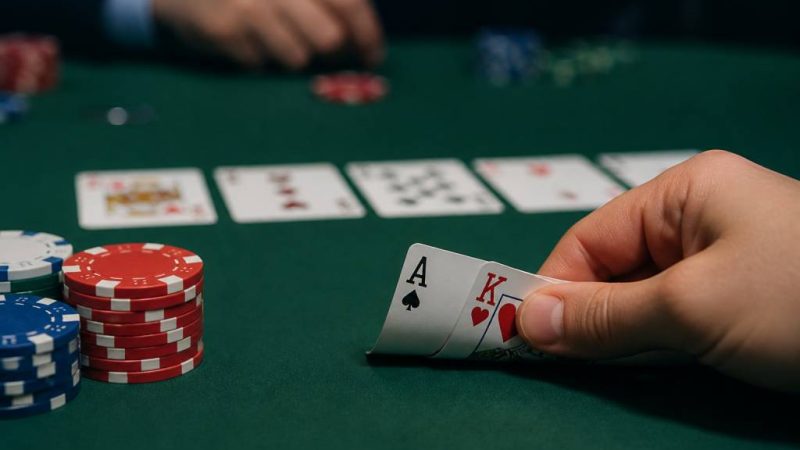
I don’t think in terms of “I have A♠ Q♠” as a one-off. I think in terms of a range: all the hands I could reasonably have in this situation. Game theory is built on the idea that:
- You have a range of hands.
- Your opponent has a range of hands.
- Your betting strategy should be designed against their entire range, not one hand.
2. Mixed Strategies
In game theory, a mixed strategy means you don’t always do the same thing with the same hand. For example, with a strong draw you might:
- Bet 70% of the time.
- Check 30% of the time.
I use this kind of randomization (sometimes literally with a mental “coin flip”) so my opponents can’t say “Mason always bets his draws” or “Mason always slowplays his monsters.”
3. Equilibrium and Unexploitable Play
In a perfect game-theory equilibrium, neither player can improve their results by changing strategy, assuming the other doesn’t change. In poker, that translates to:
- If I follow a near-GTO betting strategy, my opponents can’t exploit me, only make mistakes against me.
- If they play badly (too tight, too loose, too passive), I can deviate to exploit them while knowing how to fall back to balance when needed.
Using Game Theory to Structure Your Betting Strategy 💰
Let’s dive into how I actually apply game theory when deciding whether to bet, check, or raise. The key is to build a betting range that’s logically consistent and not easily readable.
Balancing Value Bets and Bluffs
Game theory tells me that my betting range should contain both:
- Value hands: hands that expect to get called by worse.
- Bluffs: hands that expect to make better hands fold.
If I only bet strong hands, I’m easy to exploit: my opponents just fold everything but monsters. If I bluff too often, they call me light and print money. So I aim for a ratio of value bets to bluffs that makes my opponents indifferent to calling or folding.
A simplified example on the river:
- If my bet size risks 1 pot to win 1 pot (a pot-size bet), my opponent is getting 2-to-1 on a call.
- To make them indifferent, I should have about twice as many value bets as bluffs in that spot (roughly a 2:1 ratio).
I don’t calculate this at the table every time, but I build instincts from these principles. Over time, I learn:
- Smaller bets usually mean more bluffs are allowed.
- Bigger bets require tighter bluffing frequencies.
Choosing Bet Sizes with Game Theory in Mind 📏
Bet sizing is where theory meets money. I don’t just “feel” a bet size; I think about what it does to the ranges.
Small Bets (1/4 to 1/3 Pot)
I often use small bets when:
- The board strongly favors my perceived range (like A-K-5 when I raised preflop from early position).
- I want to bet very often with a wide range: strong hands, medium hands, and some bluffs.
Game theory supports small bets on favorable textures because:
- My opponent is “capped” (they don’t have as many nut hands).
- I can profitably bet many hands, forcing them to defend widely.
Big Bets (2/3 Pot to Overbet)
I use larger bets on:
- Boards that favor my nutted hands or polarized range (either very strong or very weak).
- Turns and rivers where I want to pressure capped ranges.
Game theory tells me that when I bet big:
- My value range should be quite strong.
- My bluffing frequency must drop so I’m not bleeding chips.
An overbet, for example, usually comes from a polarized range: big value hands and pure bluffs, but few medium-strength hands. I deliberately structure my betting like this so my range makes mathematical sense, not emotional sense.
Building a GTO-Inspired Strategy from Preflop to River 🧩
I don’t need to play perfect GTO to crush most games, but I like to use GTO as a baseline. Here’s how I think about it street by street.
Preflop
Preflop is where game theory solvers have done a ton of heavy lifting. I use their outputs (or preflop charts from serious training tools) as a starting point to:
- Define my open-raising ranges by position.
- Set my 3-betting and 4-betting ranges against different positions and stack sizes.
I don’t memorize every combo, but I understand the structure:
- Strong value (like AA, KK, AK) plus some bluffs (suited connectors, suited wheel Aces) in my 3-bet range.
- More calls in position, more folds out of position, and a balanced mix of strong and speculative hands.
Flop
On the flop, I consider:
- Who has the range advantage? (Who has more strong hands here?)
- Who has the nut advantage? (Who can have the absolute best hands more often?)
If I have the advantage, theory usually favors:
- Frequent small bets on dry boards (like A-7-2 rainbow).
- More checks on coordinated, dangerous boards (like 9-8-7 two-tone), unless my range smashes them.
Turn
On the turn, ranges get more defined. I start polarizing more:
- My betting range becomes more “strong or draw,” fewer weak made hands.
- My checking range includes some strong hands to protect it (for balance).
Game theory teaches me to avoid having a checking range that’s always weak. So I’ll sometimes check strong top pair or even sets on turns where my opponent might stab too often. That way:
- They can’t auto-bluff whenever I check.
- My checking range earns money too.
River
The river is where I focus the most on value-to-bluff ratios. When I fire a big river bet, I’m asking:
- How often do I want to be bluffing here given my bet size?
- Which missed draws or weak hands are best to convert into bluffs?
Good bluff candidates usually:
- Block my opponent’s calling hands (like holding a card that makes their strong hand less likely).
- Don’t block their folding hands.
Exploitative Play vs GTO: When I Deviate 🎭
Pure GTO doesn’t care who’s sitting across from you, but I do. I use GTO as my “default defense” and then make exploitative tweaks when I spot leaks.
When Opponents Overfold
If I notice someone folding way too often versus c-bets or big river bets:
- I increase my bluff frequency.
- I choose bigger bet sizes to punish their fear.
I’m deviating from strict game theory here, but I know how to return to balanced play if they adjust.
When Opponents Overcall
If I’m up against a calling station:
- I slash my bluffing frequency.
- I value bet thinner and for bigger sizes.
Game theory gives me a stable baseline, but real money is made exploiting bad habits. The key is awareness: I want to know what balance looks like so I understand exactly how I’m deviating—and why.
Practical Steps to Bring Game Theory into Your Game 🔧
Here’s how I actually work on this away from the table.
- Study with solvers or GTO trainers: I run common spots (like BTN vs BB on standard boards) and see how the solver splits betting vs checking.
- Use simplified strategies: Instead of memorizing every detail, I build easy rules like “On A-high dry boards as preflop raiser, c-bet small with a wide range.”
- Practice randomization: I sometimes use simple counts (e.g., “on 1–7 I bet, on 8–10 I check”) in tricky spots to approximate mixed strategies.
- Track my frequencies: I review sessions and ask, “Am I betting too much, not bluffing enough, or over-folding versus aggression?”
If you’re into tools and study aids, there are plenty of software products, training sites, and even physical range charts that help bring these ideas to life. I treat them like a lab where I can test lines, then bring the distilled insights back to the felt.
Final Thoughts on Game Theory and Betting in Poker 🃏
For me, game theory isn’t about turning poker into a robot’s game. It’s about building a strong, mathematically grounded foundation, so I’m not guessing every time chips go in the middle. Once I have that baseline:
- My betting lines become more consistent and harder to exploit.
- I feel comfortable ramping up aggression against weaker players.
- I know when I’m making a conscious exploit instead of a random gamble.
If you start thinking in ranges, balancing value and bluffs, and letting game theory guide your bet sizing, your decisions will become sharper—and your opponents will find it a lot harder to figure you out. ♠️