Gutshot poker: how I play and improve my chances of hitting the straight
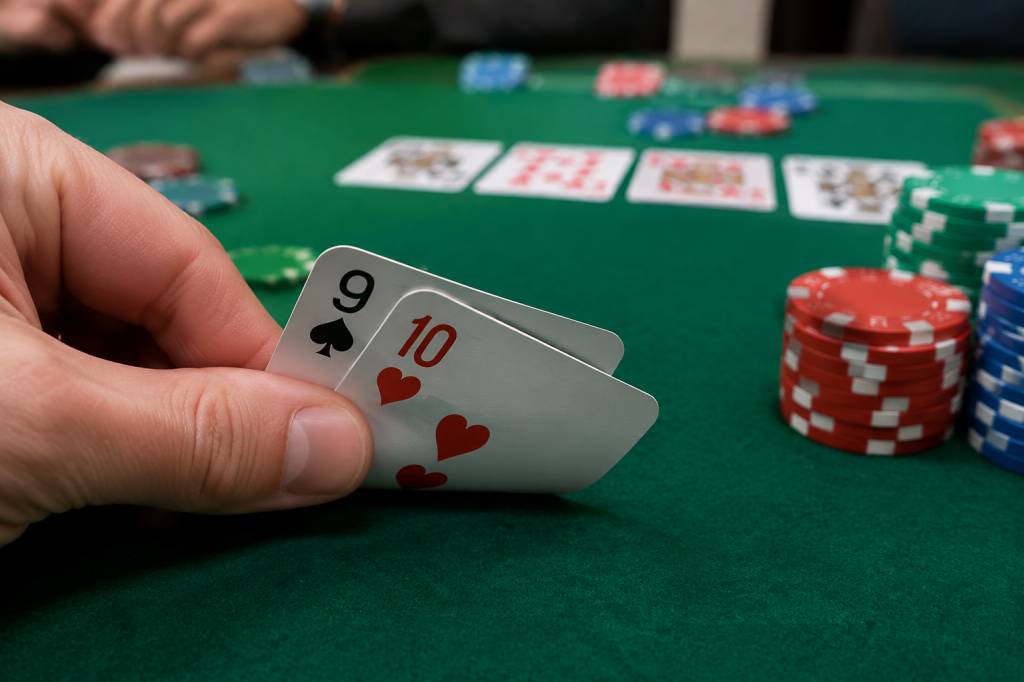
A gutshot straight draw is one of poker’s most tempting little traps. It looks close enough to touch, yet it needs one very specific card to complete the straight. Four cards can save the day, while the other 46 mostly sit there and watch your chips disappear.
I have chased plenty of gutshots over the years. Some became beautiful river stories. Others became expensive reminders that “but I could hit” is not a strategy. The trick is not simply knowing how to spot a gutshot. It is understanding when the draw is worth pursuing, how much it costs, and what happens when you actually get there.
What is a gutshot straight draw?
A gutshot, also called an inside straight draw, is a four-card sequence missing one card in the middle.
For example, if your cards and the board give you 5-6-8-9, you need a 7 to complete the straight. There are four sevens remaining in a standard deck, so you have four outs.
Other examples include:
The important detail is that the missing card must land in the middle. That is what separates a gutshot from an open-ended straight draw. With 6-7-8-9, both a 5 and a 10 help, giving you eight outs. With 5-6-8-9, only the 7 works.
Four outs can certainly win a pot, but they are not generous. The deck is not your personal waiter, and it will not bring the card simply because you have asked politely.
How likely are you to hit?
With a gutshot on the flop, you have two cards still to come: the turn and the river. With four outs, the chance of completing the straight by the river is approximately 16.5%.
That means you will miss roughly 83.5% of the time. It is worth letting that figure settle for a moment. A gutshot is not a “nearly made” hand in mathematical terms. It is a draw with a relatively modest chance of arriving.
If you see only one card, the probability is approximately 8.5%:
A useful shortcut is the rule of four and two. Multiply your outs by four when you are guaranteed to see both the turn and river, and by two when only one card remains. Four outs multiplied by four gives roughly 16%, while four outs multiplied by two gives roughly 8%.
The shortcut is not perfect, especially in large pots or unusual situations, but it is quick enough for live play. It is certainly better than staring at the dealer as if intense eye contact might influence the shuffle.
The first question: do you really have four clean outs?
Counting four outs is only the beginning. You must also ask whether those outs are clean.
Suppose you hold 8-9 and the board is 5-6-K. A 7 gives you a straight, so the four sevens appear to be your outs. But what if the board contains two hearts and you do not hold a heart? A 7 of hearts may complete your straight while also completing a possible flush for an opponent.
That card is not necessarily useless, but it is not as comfortable as the other three sevens. You may make your hand and still lose. These are often called dirty outs.
Before investing more chips, consider:
This is where many hopeful players get into trouble. They count four outs as if every one were a guaranteed ticket to the pot. Poker is less generous. Sometimes your “winning card” is merely the card that loses slightly less often.
Gutshot versus open-ended draw
An open-ended straight draw is usually stronger because it has eight potential outs. If you hold 6-7 on a board of 4-5-K, any 3 or 8 completes a straight.
That gives you approximately a 31.5% chance of hitting by the river when you see both remaining cards. A gutshot, by comparison, gives you around 16.5%. The difference is significant.
Still, the number of outs is not the only factor. A gutshot can be more valuable when it comes with additional possibilities. For example, holding A-5 on a board of 6-7-K may give you a gutshot to an 8, plus an overcard, backdoor flush potential, and useful blockers. The hand is not automatically worth playing, but it has more ways to improve than a bare gutshot.
On the other hand, a weak gutshot with no additional equity can be a very expensive lottery ticket. If you are drawing to the bottom end of a straight and your opponent is showing serious strength, folding is often the more profitable move.
Pot odds: the number that stops the bleeding
The key question is not, “Can I hit my straight?” You can. The better question is, “Am I being offered the right price to try?”
If you have four outs and only one card to come, you have roughly an 8.5% chance of hitting. To call a bet purely on the draw, you generally need pot odds that justify that probability. Ignoring future betting for a moment, you need to win approximately 10.8 times the amount you call in total pot value to make a break-even call.
Here is a simple example:
The pot is £80, and your opponent bets £20. You must call £20 to compete for a final pot of £120. Your call represents 16.7% of the final pot, while your chance of hitting on the river is only about 8.5%. If you have no additional ways to win and no implied odds, this is usually a fold.
Now imagine the pot is £100 and your opponent bets only £5. Calling £5 to compete for £110 is a much better price. You still will not hit very often, but the cost is small compared with the potential reward.
Always calculate the price before allowing the draw to pull you in. I once called a surprisingly large turn bet with a gutshot because I had already invested chips earlier in the hand. That was not a poker decision. It was me trying to rescue money that had already left the building. Sunk-cost thinking is a terrible card player.
Implied odds and future action
Sometimes a direct pot-odds call is not quite profitable, but implied odds make it attractive. Implied odds refer to the extra chips you expect to win if you hit your draw on a later street.
For example, suppose you are deep-stacked against an opponent who has a strong but vulnerable hand. You call a small flop bet with a gutshot, expecting that a straight on the turn could win a sizeable additional bet. That future money may make the call reasonable.
However, implied odds should not become an excuse to call every draw. They depend on several things:
A gutshot is more attractive when it is hidden. If the board suddenly announces a four-card straight, even a recreational player may decide not to donate another stack. The dream of implied odds can vanish faster than a bluff after someone wakes up with aces.
Position makes a big difference
Playing a gutshot in position is far easier than playing one out of position. When you act last, you can see whether your opponent checks, bets, or shows unusual weakness before making your decision.
In position, you may also win the pot without hitting. A well-timed bet after your opponent checks can sometimes take down the pot immediately. That extra fold equity adds value to your draw.
Out of position, the situation becomes more awkward. You may check and face a bet. You may lead and get raised. Even when you hit, you have less control over the size of the pot. A weak gutshot out of position is often best treated with caution, particularly against an aggressive player.
Position does not magically create extra outs, but it can improve the overall profitability of the hand. Poker is not only about the cards you hold. It is also about who has to speak first.
Using blockers and backdoor possibilities
Blockers matter because your cards remove certain combinations from your opponents’ possible holdings. If you hold the ace of a suit, for example, your opponent is less likely to have the nut-flush draw in that suit.
With a gutshot, blockers can also influence whether a bluff is sensible. Holding a card that blocks your opponent’s strongest calling hands may make a semi-bluff more attractive. This is especially relevant in no-limit hold’em, where a bet can win the pot immediately or give you a chance to improve.
Backdoor draws can add useful equity too. A hand such as 8♠7♠ on a flop of 5♦-6♣-K♠ has a straight draw and some backdoor flush potential. The flush will need two spades on the turn and river, so it is not a primary plan, but it contributes to the hand’s overall possibilities.
Do not overvalue these extras. A backdoor flush is a bonus, not a reason to throw half your stack into the middle. Poker players love discovering hidden possibilities after they have already made a bad call. Try to identify them before the chips move.
When I prefer aggression
I am more willing to play a gutshot aggressively when several conditions line up. I want position, reasonable stack depth, fold equity, and an opponent who can fold. I also prefer boards where my draw is disguised and my story makes sense.
Consider holding 9-10 on a flop of 7-8-A. You have an open-ended draw, not a gutshot, but the same principles apply. Now imagine holding 9-10 on a flop of 7-J-A. You have a gutshot to an 8. If your opponent checks frequently on ace-high boards, a bet may be profitable because you can win immediately or improve later.
Against a player who never folds a pair, however, bluffing becomes less appealing. Your fold equity disappears, leaving you dependent on those four outs. That is a poor arrangement unless the pot odds are excellent.
Against a tight player, a gutshot can sometimes be used as a semi-bluff. Against a calling station, it is often better to check back or fold, depending on the price. There is no prize for making the most dramatic decision at the table.
When I let it go
I usually fold a gutshot when the bet is large, the pot is small, the draw is dirty, and there is little chance of winning without improvement. That combination is not exciting, but neither is watching your bankroll slowly develop a limp.
Be particularly careful when:
Multiway pots can be deceptive. The larger pot may make the call look attractive, but opponents are also more likely to hold strong combinations. Your four outs do not multiply just because more people have entered the hand.
A practical hand example
Imagine you raise before the flop with 8♣9♣, and one player calls. The flop comes 5♦-6♠-K♥. You have an open-ended draw here, with any 4 or 7 helping. The situation becomes more interesting if the board instead comes 5♦-7♠-K♥. Now you need a 6 to complete the straight, giving you four outs.
Your opponent bets half the pot. You should consider the pot odds, your position, stack sizes, and the opponent’s likely range. If you are in position and expect to win extra chips when the 6 arrives, calling may be reasonable. If you are out of position against a player who barrels every turn, the call becomes less appealing.
If the turn brings the 6♥, do not automatically assume the hand is over. Look at the board again. Could a flush draw have arrived? Could your opponent already have a higher straight? What size bet makes sense now? Completing your draw improves your hand, but it does not remove the need to think.
How to improve your gutshot decisions
The fastest way to improve is to review hands away from the table. Mark every gutshot spot and ask what information you had at the time, not what you discovered after seeing the river.
You can also practise estimating probabilities until the numbers become automatic. Four outs on one card: about 8%. Eight outs on one card: about 17%. Four outs across two cards: about 16.5%. These figures will not make every decision easy, but they will stop you from treating a gutshot like a coin flip.
The mindset that keeps gutshots profitable
A gutshot is a possibility, not a promise. The best players do not avoid gutshots entirely, nor do they chase them blindly. They compare the price with the chance, add the value of position and fold equity, and accept that folding can be the correct move even when the missing card feels tantalisingly close.
When the odds are right, take the shot. When the price is wrong, save the chips for a better opportunity. And when the 7 finally arrives on the river after you made a disciplined fold, remember that poker is not a test of whether you would have won. It is a test of whether your decision was profitable before the card was dealt.